
Blog
Best Packaging for Food Delivery That Holds Up

A meal can leave the kitchen looking excellent and arrive looking rushed, spilled, or cold around the edges. For delivery-focused operations, the best packaging for food delivery is not a single container type. It is a matched system that protects the meal, supports fast packing, and gives customers a consistent impression of your brand. SmartPackingUSA helps commercial kitchens build that system around their menu, production volume, and container requirements.
The right choice starts with the food itself. A saucy pasta bowl, a chilled meal-prep entrée, a family-size catering pan, and a refrigerated pet food portion do not face the same packaging demands. Container depth, material, lid or film choice, and sealing method must work together before a driver ever picks up an order.
What Food Delivery Packaging Must Do
Delivery packaging has a demanding job. It must hold food securely through stacking, vehicle movement, handoffs, and customer handling. It also needs to support an efficient packing line, especially when orders arrive in waves during lunch, dinner, or weekly meal-prep fulfillment.
A practical packaging system balances five operating needs: leak resistance, food separation, temperature suitability, speed of assembly, and presentation. If one of those areas is weak, the cost shows up elsewhere. Staff may spend extra time taping lids, remaking spilled orders, double-bagging containers, or responding to customer complaints.
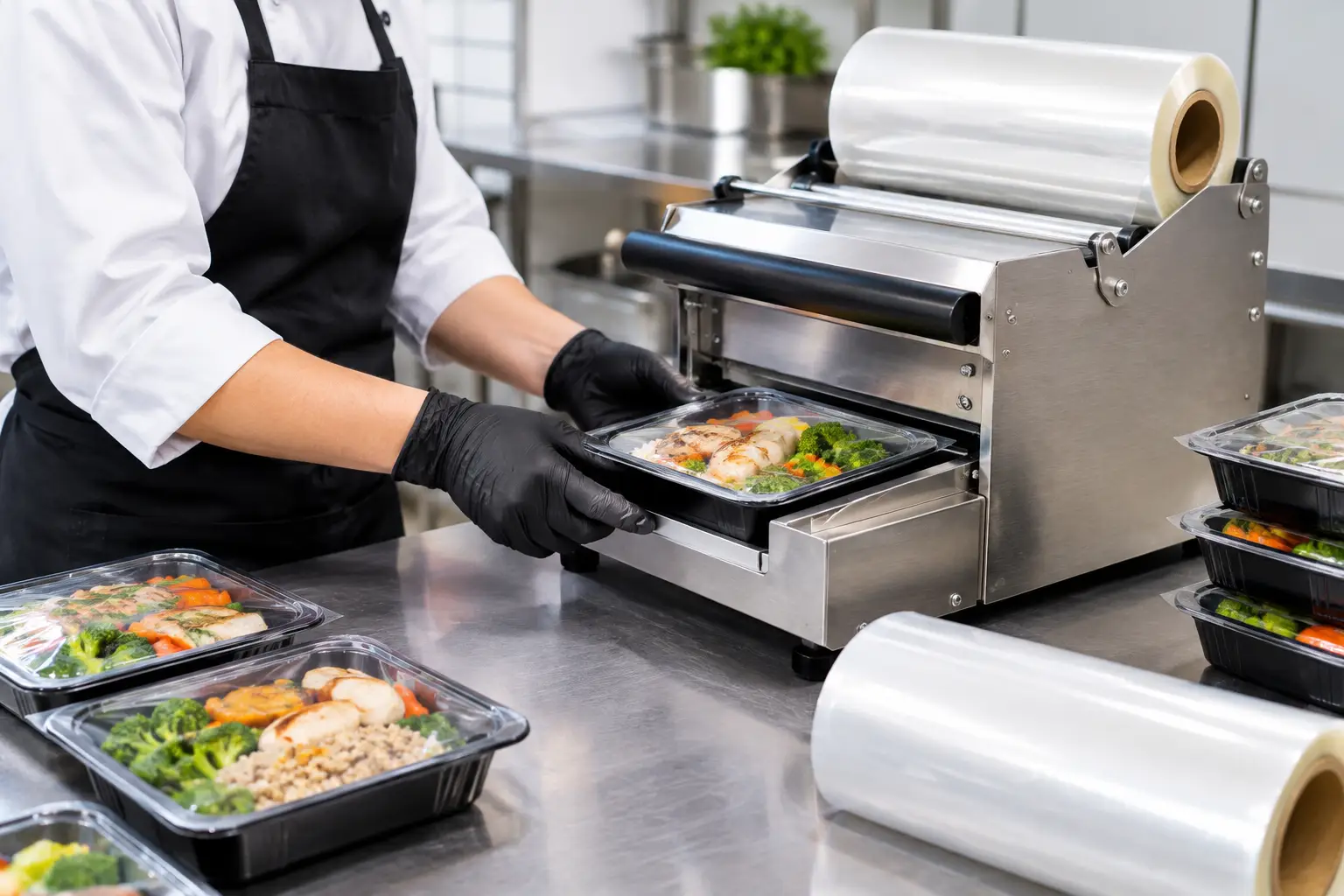
For many prepared-food businesses, tray sealing provides a more controlled alternative to loose-fitting lids. A properly matched tray and sealing film create a clean, secure closure that can improve consistency from one order to the next. It also gives the finished meal a more organized, retail-ready appearance for delivery, grab-and-go displays, and weekly subscription programs.
Start With the Menu, Not the Container
Choosing packaging by price alone often creates avoidable problems. Start with how the product behaves during preparation, storage, transport, and reheating. That process quickly narrows the right material and tray style.
Saucy, oily, and liquid-heavy meals
Soups, curries, braised meats, pasta dishes, and dressings need secure closures and a tray shape that minimizes movement. A shallow tray that is overfilled can push food into the seal area, which may interfere with closure quality. Deeper containers or appropriately portioned compartments can be a better fit when the menu has generous sauces or multiple components.
For these applications, the compatibility between the tray flange, film, and machine settings matters more than simply choosing a thicker container. SmartPackingUSA can help match trays and sealing materials to the intended application so operators are not left testing unrelated components from multiple suppliers.
Multi-component meals
Meal-prep operators and ghost kitchens frequently package proteins, starches, vegetables, sauces, and sides in one order. Compartment trays help keep ingredients separated, preserve presentation, and reduce the chance that a crisp side becomes saturated by a sauce during delivery.
The trade-off is flexibility. A multi-compartment tray works well for a repeatable menu, but it may not suit rotating specials or portions that change from week to week. If menu variation is high, a small group of versatile single- and multi-compartment formats can simplify inventory without forcing every meal into the same configuration.
Hot meals, chilled meals, and reheating needs
Temperature exposure should guide material selection. Plastic, sugarcane, cardboard, CPET, and aluminum containers each serve different operational needs. A packaging decision should consider whether meals are packed hot, held chilled, displayed for retail sale, or reheated by the customer according to the container’s intended use.
CPET and aluminum containers are commonly considered for prepared meals where heat performance is part of the application. Sugarcane and cardboard options can support operations seeking fiber-based formats, while plastic containers remain a practical choice for many cold and prepared-food applications. The best option depends on the product, the customer experience you want to create, and the packaging process in your kitchen.
Why Sealed Trays Improve Delivery Operations
A tray-sealed meal does more than close a container. It can make the packing station easier to manage. Operators place the filled tray, apply the matched film or foil lid, and create a consistent finished package with less reliance on manually snapping on individual lids.
That consistency matters when volume increases. Staff can follow a repeatable workflow, trays stack more predictably, and finished meals have a cleaner appearance. For meal-prep businesses, caterers, commissary kitchens, and food manufacturers, a standardized package also makes portioned products easier to organize before dispatch.
Machine capacity should match actual workflow, not just a maximum number on a specification sheet. Selected Smart Packing USA tray sealing machine models can reach approximately 600 trays per hour with a single operator, depending on tray size, operator workflow, and production conditions. A growing operation may not need that output on day one, but choosing equipment with the right fit can prevent packaging from becoming the bottleneck later.
A complete system prevents compatibility problems
A common production-floor issue is sourcing trays, lids, film, and machinery separately, then finding that the seal is inconsistent or that the material does not run efficiently. The best packaging for food delivery depends on compatibility across the full system.
SmartPackingUSA supplies tray sealing machines, food containers, sealing films, foil lids, and custom packaging options as coordinated components. This approach helps businesses select the container dimensions, film format, and machine configuration that suit their packaging line. For operations using a unique tray size or developing a branded format, custom molds and custom-size machine development can be part of the conversation.
Choose Materials That Match Your Brand and Workflow
Packaging communicates before the customer takes the first bite. A clear plastic tray can showcase colorful meal components. A fiber-based sugarcane or cardboard container may better fit a brand that prefers a more natural presentation. Aluminum can give catering and oven-ready applications a familiar, durable format.
Branding does not have to mean a completely custom container from the start. Branded sealing films can add a professional, recognizable finish while retaining a practical tray format. This is especially useful for meal subscriptions, regional food brands, and grocery-ready prepared foods that need to stand out without slowing down the packaging line.
Material choices still need to work in real conditions. Consider how containers will be stacked, whether they will encounter moisture, how much food weight they carry, and what kind of bags or delivery handling they will experience. Samples are valuable because they allow your team to evaluate filling, sealing, holding, and delivery performance with your actual menu.
Evaluate the Packing Line Before You Buy
The best packaging decision is made at the packing table, not only in a product catalog. Watch the workflow from portioning through final bagging. Note where employees pause, where containers become messy, and which menu items need special handling.
Ask practical questions. Can the team fill the tray without contaminating the seal area? Does the package fit your standard bag? Can it be labeled quickly? Does the tray footprint make sense for storage and delivery stacking? Are you managing several container styles that could be consolidated?
Equipment design matters here as well. Commercial operators should look for durable construction, straightforward controls, sanitation-friendly surfaces, training support, and warranty coverage. The goal is not to add complexity. It is to create a dependable packing process that staff can run consistently during busy service periods.
For high-volume operations, calculate packaging needs around realistic demand patterns. A restaurant may need fast output only during two peak windows. A meal-prep company may package hundreds of orders on one or two production days. A caterer may require flexibility for changing pan sizes and event menus. Those are different operating models, and they deserve different machine and packaging recommendations.
Build for Growth Without Overbuilding
A smaller operation does not always need the largest machine or the broadest inventory range. Overbuying can tie up cash and create storage challenges. At the same time, selecting packaging that only works at low volume can make growth expensive and disruptive.
The practical middle ground is a system that fits today’s menu and offers room to standardize as order volume rises. Choose tray formats your team can use across multiple menu items where possible. Keep sealing supplies aligned with the machine. Establish reliable bulk ordering for core containers and films. Then add custom packaging or greater production capacity when demand supports it.
SmartPackingUSA works with food businesses that need more than a box of containers. From product samples and bulk orders to machine training, custom projects, warranty coverage, and after-sales support, the focus is on creating a packaging setup that performs on the production floor.
A delivery order is one of the few moments when your kitchen hands the customer a physical version of your brand. Choose packaging that makes that handoff clean, secure, and repeatable, then test it under the same conditions your customers will experience.
